AI Receptionist
AI Receptionist for After-Hours Towing Calls: How Repair Shops Catch Every Breakdown Customer
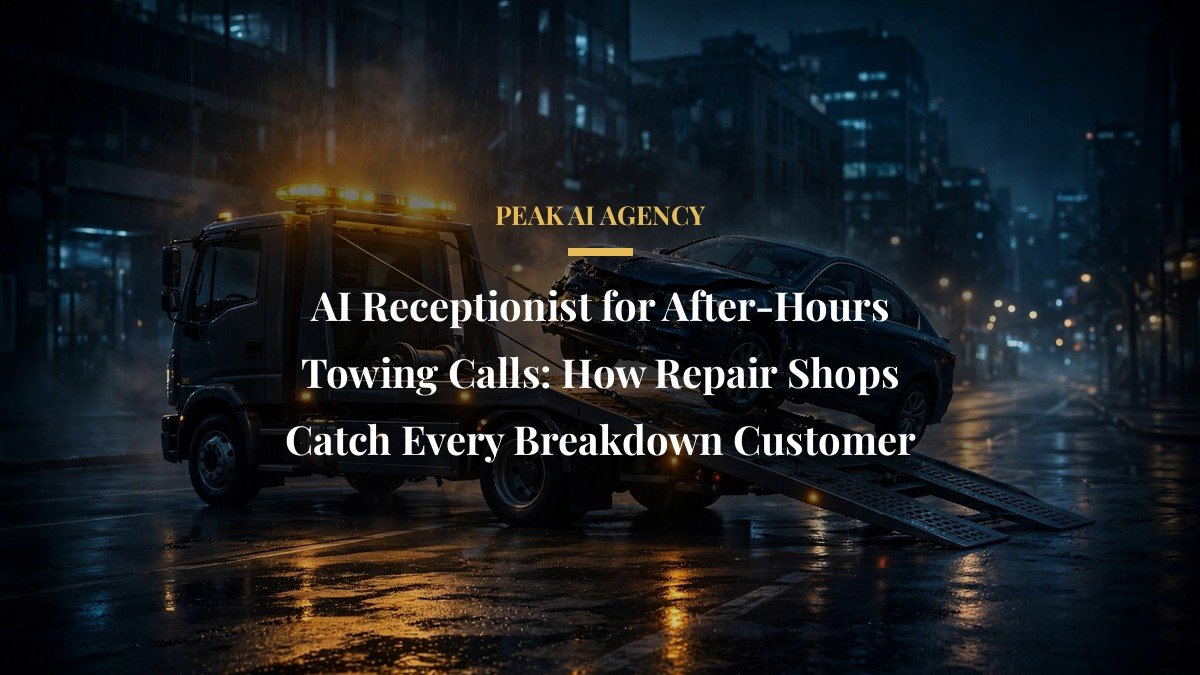
It’s 9:40 at night. A driver is standing on the shoulder of the highway with a car that just died, and she’s calling the shop whose number came up first in her search. If your shop doesn’t answer, she doesn’t leave a voicemail — she calls the next number. That single missed call is a tow dispatch, a diagnostic, and very likely a full repair order walking into someone else’s bay.
After-hours breakdown calls are the highest-value phone calls a repair shop gets. The caller is stressed, they’re in an urgent situation, and they have every intention of spending money right now. No other call type converts like this. And no other call type is as routinely missed, because most of them happen when the shop is closed.
An AI receptionist for towing and after-hours emergency calls exists for exactly this moment. It answers at 2 a.m., triages the situation, dispatches or books the tow, captures the vehicle details, and schedules the intake for first thing in the morning — so the car and the customer both show up at your door instead of a competitor’s.
Why breakdown calls behave differently from every other call
Normal service calls are deliberative. A customer price-shops an oil change, calls back tomorrow, waits for payday. Breakdown calls are the opposite: the decision window is minutes long, and whoever answers first usually wins the job. The caller needs help now, and “we open at 8 a.m.” — even said politely — is an invitation to keep dialing.
The economics are brutal. Reporting on the auto repair industry has found that shops miss between 20 and 40 percent of inbound calls overall, and that up to 80 percent of callers who reach a generic voicemail hang up without leaving a message. That number describes a calm caller at noon. A driver on a dark shoulder is not leaving a message. Ever.
There is also a compounding effect. Breakdown callers rarely need just a tow. The tow turns into a diagnostic, the diagnostic turns into the repair, and the repair — handled well — turns into the customer’s new permanent shop. Losing the tow call doesn’t lose one transaction; it loses the customer.
What an AI receptionist actually does on a breakdown call
A breakdown call has three jobs, and the AI handles all three in one conversation:
1. Triage. The first thing the caller needs is reassurance that help is coming. The AI asks where the vehicle is, whether everyone is safe, and what the vehicle is doing. If the caller is on a highway shoulder, it tells them to stay in the vehicle with hazards on while it arranges help. That thirty seconds of competent triage is what keeps the caller on the line instead of hanging up to call someone else.
2. Tow coordination. Shops handle this differently, so the AI is configured to match your operation. Some shops dispatch their own rollbacks; others use a preferred tow partner. The AI collects the pickup location, vehicle year/make/model, drivetrain if relevant, and a destination, then either pages the driver on your rota or confirms the partner’s ETA. Either way the caller gets one clear answer: “A truck is on the way, about 35 minutes.”
3. Intake capture. While the tow is sorted, the AI takes the customer’s name, callback number, the vehicle’s symptoms, and schedules the diagnostic intake for when you open. By the time you unlock the doors in the morning, the RO is half-written: customer identified, vehicle described, tow confirmed, bay slot tentatively held.
The questions shop owners always ask about after-hours AI
“Won’t callers hang up when they hear it’s a robot?” In an emergency, callers care about getting help, not about who answers. Modern AI phone agents sound like a calm, competent dispatcher — and they never sound sleep-deprived at 2 a.m. Industry reporting has noted that callers are often more willing to interact with an AI agent than to leave a voicemail, because the AI actually responds. The bar the AI has to beat is not a human dispatcher. It’s voicemail, which callers have already voted against.
“What if the AI books something we can’t do?” It won’t, because it only books what you teach it. The tow radius, the partner list, the vehicles you don’t service, the hours you take drop-offs — all of that is configured during setup. Anything outside the rules gets flagged for a human callback first thing in the morning, with the full conversation summary attached. Nothing silently slips through.
“Do we need to change our tow partners or process?” No. The AI sits in front of your existing process. Your rota, your partner numbers, your after-hours drop-off procedure — the AI executes the process you already have, it just does it at the exact moment the caller needs it instead of the next morning.
How the money actually flows
Breakdown calls carry a different revenue profile than routine bookings. A breakdown customer almost always authorizes a diagnostic, and a stranded driver rarely shops the repair — they approve the fix that gets their car back. Add the tow itself, and each answered after-hours call can easily become one of the highest-value repair orders the shop writes that week.
This is also where emergency-rate revenue enters the picture. Shops that handle after-hours emergencies well can justify premium pricing for the convenience — but only if the customer is actually spoken to. A voicemail box can’t quote emergency rates. An AI receptionist can, and it can do it the same way every time, without the tech who got woken up accidentally low-balling the job.
Compare that to the alternative staffing model. Keeping a human on call through the night for a handful of calls a week is an expensive way to cover after hours — and the human on the rota is often the owner, which is its own kind of cost. The AI takes every call for a fraction of that, and it answers the routine ones (hours questions, appointment bookings) that don’t need a tow at all.
What the morning-after workflow looks like
Here’s the part owners care about most: does this create chaos the next morning? It shouldn’t. A well-configured setup delivers three things before you open:
- A call summary for each overnight call — who called, what broke, where the vehicle is, what was promised.
- A tow log — which tows were dispatched, through which partner, with ETA records.
- Pre-built intake records — customers already identified and vehicles already described, ready to turn into repair orders.
The advisor’s morning starts with information instead of a cold voicemail inbox. And the customer who called at 9:40 last night gets a human follow-up at 8:05 confirming their appointment — which is exactly the experience that turns a breakdown into a lifelong customer. For the ongoing side of the job, estimate and status-update handling keeps that goodwill compounding through the repair.
Setting it up right the first time
Four configuration decisions determine whether your after-hours AI is a revenue machine or a disappointment:
1. Define the triage rules. What counts as an emergency worth dispatching a tow versus a morning callback? A car that won’t start in a driveway is different from a car on a highway shoulder. Write both paths down; the AI will follow whichever you choose.
2. Lock in the tow flow. Own trucks, partner numbers, radius limits, who gets paged and in what order. This is the single most important piece of configuration. Test it with real calls before you rely on it.
3. Set the promise policy. What is the AI allowed to promise? ETAs, pricing ranges for tows, whether a loaner will be waiting. Overpromising at 2 a.m. creates a problem at 8 a.m. Underpromise slightly and let the morning team overdeliver.
4. Plan the morning handoff. Who reads the overnight summaries, who confirms the tows, who calls the customers back. The AI does the night shift; the morning shift needs its five minutes of process to close the loop.
The bottom line
After-hours breakdown calls are the highest-converting, least-competed calls in your market, because most shops simply don’t answer them. An AI receptionist lets a small shop answer like a 24-hour operation without staffing like one. The driver on the shoulder gets help, the tow comes to your lot, and the morning starts with revenue already on the schedule. The shops that figure this out first in their market get a durable advantage — because the breakdown caller who becomes your customer rarely goes back to searching.

I write the agents that run on clinic phone lines and inboxes: the conversation engine and the booking logic behind them, plus the integrations with Pabau, Fresha and Phorest. Everything here comes out of systems we have actually shipped, not a content plan.